


Led design efforts across 100+ mini learning games and interactive modules for millions of K12 students reaching diverse classrooms
Created scalable design systems that unified games, cut visual inconsistencies and sped production at scale
Experimented with emerging tech like Phy-gital tablets, VR, 3D simulations contributing to new business opportunities and product lines.
Collaborated with pedagogy experts, learning designers and engineers to translate abstract learning objectives into playable and explorable experiences.
Managed production at scale with coordinated efforts between vendors and design firms using design systems and guideline documentations.
Context
Students learning math and science concepts rely on traditional learning materials like classroom lectures, textbooks and worksheets. This leaves limited space for inquisitiveness or imagination.
Game based learning breaks down complex learning objectives into engaging and easy to understand content. With learning games and simulations, students are encouraged to explore, fail, and retry in a low-stake, safe environment.
This case study is a curated collection of projects done for two large scale edu-tech platforms from India. BYJU’s and Educational Initiatives.

Why It Mattered To Me
From designing for entertainment to designing for impact
When I started in game design, I was designing casual and social games for entertainment. But I was searching for something fulfilling. I wanted to use my design skills to positively impact user behaviors and improve quality of life.
Building game based personalized learning experiences felt like the perfect intersection. I could design for fun and impact. I learnt good design is reducing the frustration and boredom a kid feels with rote learning and start seeing learning objectives as a puzzle to solve.
Design Leadership: Set visual and interaction patterns for 100+ games, simulations and interactive experiences. Worked closely with pedagogy experts, learning designers, and engineers to ensure design served learning objectives.
Research in the real world: Conducted several ethnographic studies in classrooms (both private and government aided) to understand about learning gaps and misconceptions of students from different backgrounds.
Scope management: Coordinated with multiple design firms and art vendors to maintain visual consistency across massive projects. Developed deign systems, UI kits and art guidelines that teams could scale with.
Emerging tech: Experimented with VR, ‘Phy-gital’ tablet experiences and 3D simulations that paved way for new business ventures.


The Problem
Breaking complex learning concepts for easy understanding.
While I was not directly involved in all aspects of user research, insights from curriculum experts, teachers and sales team guided us towards designing for and solving the right problem.
The learning games, interactive and in-app experiences had to enhance students learning experience by nudging them towards a journey of exploration and self discovery.
Each student goes on a learning path that is vastly different from one another. The interactive experiences had to aid the students in their personal learning journey without distracting them.
BYJU’S GPT Models
Nudges for the new age learner
What is it:
Around June 2023, BYJU’s introduced three GPT models aimed at teaching complex learning concepts at a granular level for students. BADRI, Math GPT and Teacher GPT were to be launched as part of BYJU’s the learning app (BTLA)
Challenge:
The GPT model based recommendations, instructions and nudges had to feel personal and humane without sounding authoritative. We designed unique experiences for the four tenets of gaining knowledge like Revise, Learn, Practice and Discover.
Design Solution:
I explored several wireframes and low fidelity prototypes for UI cards and messaging to inform students of their learning habits. I used animation, icons and visual cues of cityscape background to drive attention to the UI cards.

BYJU’S Math Solver
Step by step solver for complex mathematic equations
What is it:
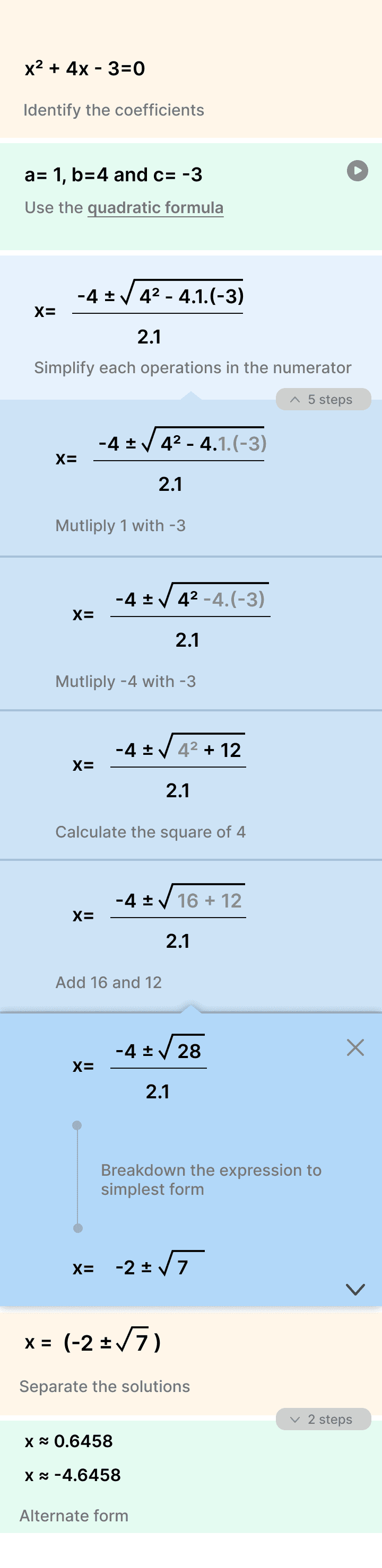
Math solver was an experimental framework to go deeper into complex mathematic concepts like quadratic and polynomial equations. Students would be able to see complex formulas stripped down step by step showing until the final solution.
Challenge:
Having the solver work smoothly in mobile touch points was an interesting challenge. We approached this framework mobile-first and studied best practices across competitor products like photomath and microsoft math solver.
Design Solution:
I did a series of wireframe prototypes using accordion style design pattern to expand and collapse on equation steps. We experimented with color values, frames with pointers, side bars as a way to establish connection between a main equation and its solution sub-steps.

BYJU’S Math companion
Micro learning with a buddy
What is it:
A redesign of interactive math lessons for student in K-9 through K-12, built on the teaching style of Prof. Edward Burger.
Insights:
The original version used Geogebra (a dynamic math software). Heatmap recordings revealed students simply rage clicked “next”, or skipped sessions altogether.
We assumed students wouldn’t want distractions while learning serious concepts. We were wrong. Initial A/B testing revealed that students preferred a guide. Virtual buddies that explained and guided students along the way
Challenge:
Designing within a 720×720 px iframe container meant every element had to count. I worked closely with learning designers and pedagogy experts to map out key concept breakdowns.
Design Solution:
Introduced animated companion characters that guided students step-by-step. More importantly, we broke complex math concepts into digestible micro-lessons.


BYJU’S Labs
Conceptual clarity through immersive experience
What is it:
BYJU’S - Learning station is an android tablet device aimed at short-form learning content, quick revision resources and personalized micro-lessons and interactions.
Insights:
The learning content were in the form of 2D / 3D simulations and VR experiences. The pedagogy content were broken down into independent short-format experiences that were interspersed between the main learning modules.
Challenge:
Working on emerging tech meant that we had limited devices to test the experience, figuring out production pipeline between Unity team, 3d artists and content experts.
We navigated the blind spots by using web-based XR viewers and plugins to test interface ideas and user progression.
Design Solution:
I jumped in early to help the team decide on interface styles and interaction patterns. Followed by creation of reusable UI kits and scalable components so the Unity team could move fast without compromising quality.


Gamification Systems
Buddies, badges and leaderboards
What is it:
Beyond games and interactive content, I had the opportunity to design the emotional layer for two large scale learning apps (B2B and B2C). This includes virtual badges, progress indicators, character companions and personalized UI cards that improved stickiness and engagement.
Insights:
Ethnographic observations of classrooms showed us when and how rewards actually motivated students. While younger kids loved visual badges and avatars; older students cared more about progress tracking and peer comparison.
Design Solution:
The digital rewards were designed thoughtfully around core learning objectives and not just slapped on top. I was involved in exploring several design mockups, character set, illustrations and animated prototypes to convey the reward systems.
Unlockables
Buddy Customization


Buddy Customization: Created character lineups and customization kits for virtual buddies based on student grades. Everything from occupations to pop cultural references were explored.
Badges
Exploratory Badges








Badges: Worked closely with vendors in creating a library of digital badges that were based on student activities like learning goals, topics attempted, worksheet and homework performances.
Retrospective
If I could measure Impact
While my role was not directly involved in measuring impact of the learning games and interactives or how they influenced learning outcomes, I would track these key KPI metrics to understand effectiveness.
Completion rate: Percentage of students finishing the lessons v/s abandoning them
User behavior heatmaps: Did students struggle with the interactive flow or got stuck, rage clicked to quit a session.
Time on task: Average time spent on concept task.
Concept retention: A pre and post test comparison showing efficacy of the games, interactives and engagement frameworks
Return rate and streak data: data on DAU/WAU and other login patterns to gauge engagement
Impact > Engagement
Over seven years, I contributed to digital experiences that reached millions of students across India. From young kids in government aided schools to teens struggling with concepts like fractions or chemical reactions. Seeing a student light up during a game we built and finally understanding something tricky? That’s been one of the most rewarding parts of my career.
Test with real students and as often as possible
Classroom observations revealed what prototypes missed. Lower grades gravitated towards playful guides, higher grades preferred nudges and progress tracking. I learned not to assume. Watching students interact showed what truly worked.
Creating spaces for safe failure
Games and interactive experiences needed room for kids to try, mess up and try again. This principle guided us to simplify navigation and user flow that encouraged starting over.
Designing Hybrid interfaces
Creating for Phy-gital tablets or VR experiences taught me to think beyond limitations. Using free tools and plugins as workarounds allowed me to validate assumptions in the absence of actual devices.